Why PMs Must Embrace Vibe Coding
In this era of rapid AI acceleration, as a Global AI SME, I’ve been closely observing the paradigm shift in project collaboration. Lately, I've been hearing a common refrain from some of my engineer friends: "Project Managers don't need to learn Vibe Coding (natural language programming)—just write clear requirements." Some even dismiss it as a gimmick or PMs trying to encroach on their territory.
I firmly believe that behind this seemingly professional territorialism lies a subtle anxiety about being replaced by AI. Frankly, this attitude isn't just arrogant; it’s highly irresponsible to the project and the client .
Looking back at our battle scars from leading projects, every PM knows this scenario too well: We uncover a highly valuable customer need on the front lines, excitedly bring it back to the team, only to be hit with, "That’s a technical impossibility," or "Engineering is strapped right now; we have a resource constraint." The result? We throw our hands up and turn the client down. Opportunities to make the product shine are lost simply because of internal development bottlenecks.
This is exactly why I advocate that PMs must master Vibe Coding. When a client shares a pain point, PMs can no longer afford to be passive messengers waiting for engineering to pronounce a death sentence on an idea. Instead, we need to take the initiative and translate the solutions in our heads into concrete action plans.
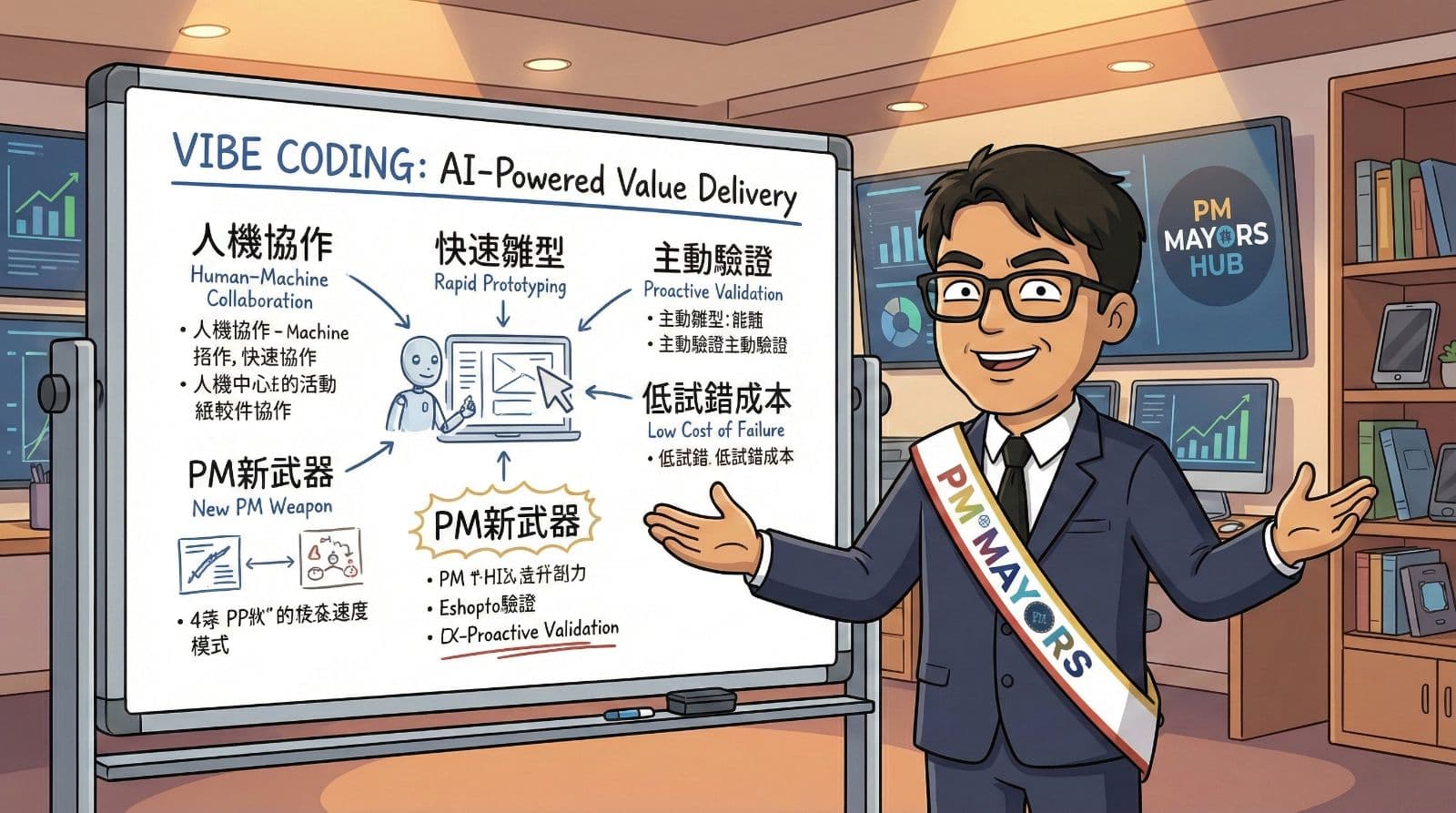
This skill—"Vibe Coding"—is fundamentally different from traditional software development. It is the ultimate weapon for PMs to master human-machine collaboration . Through natural language guidance, PMs can get their hands dirty building rapid prototypes or automated scripts. In this process, PMs don't need to understand obscure backend architecture; they are learning how to communicate and coordinate with AI. When PMs can validate feasibility themselves, it’s not just a massive leap in communication efficiency—it demonstrates to the entire team how to accurately capture requirements and deliver real value, even when resources are tight.
What excites me the most is that this skill liberates PMs from traditional resource constraints. I don't want a PM's value to stop at writing documentation and chasing down ticket statuses. I want them to bring a functional MVP to the table and proudly tell the client, "Here is the initial solution I built for you!" Delivering this tangible business value firsthand is the true project dividend of the AI democratization era.
To make this vision a reality, I—your "PM Mayor"—am calling it out loud and clear: PMs, boldly embrace Vibe Coding. I know many of you want to try but might feel intimidated by the engineering domain. Please remember, this isn't about stealing the engineers' jobs of writing foundational architecture. It's about taking back ownership of our products through incredibly low-cost experimentation. This is just the starting point. Through AI, we are teaching ourselves to break free from resource limitations and dance with AI, rather than just acting as passive translators of requirements.
This isn't just a wake-up call for the project management circle; it's a memo from the PM Mayor to the agile teams of the future. Let's set aside the arrogance and the fear. Let engineers focus on solving the truly complex, foundational technical challenges , and let PMs use AI to rapidly validate business value. Let's embrace these new tools together and find our footing in the changing landscape of the future workplace. This is an adventure to find a win-win in the AI wave, and a crucial opportunity for us to evolve alongside our development teams.
Tags:
Want to Know More?
Get in touch to discuss AI transformation, teaching or speaking
