When AI Agents Get Stronger, BAs Become More Critical
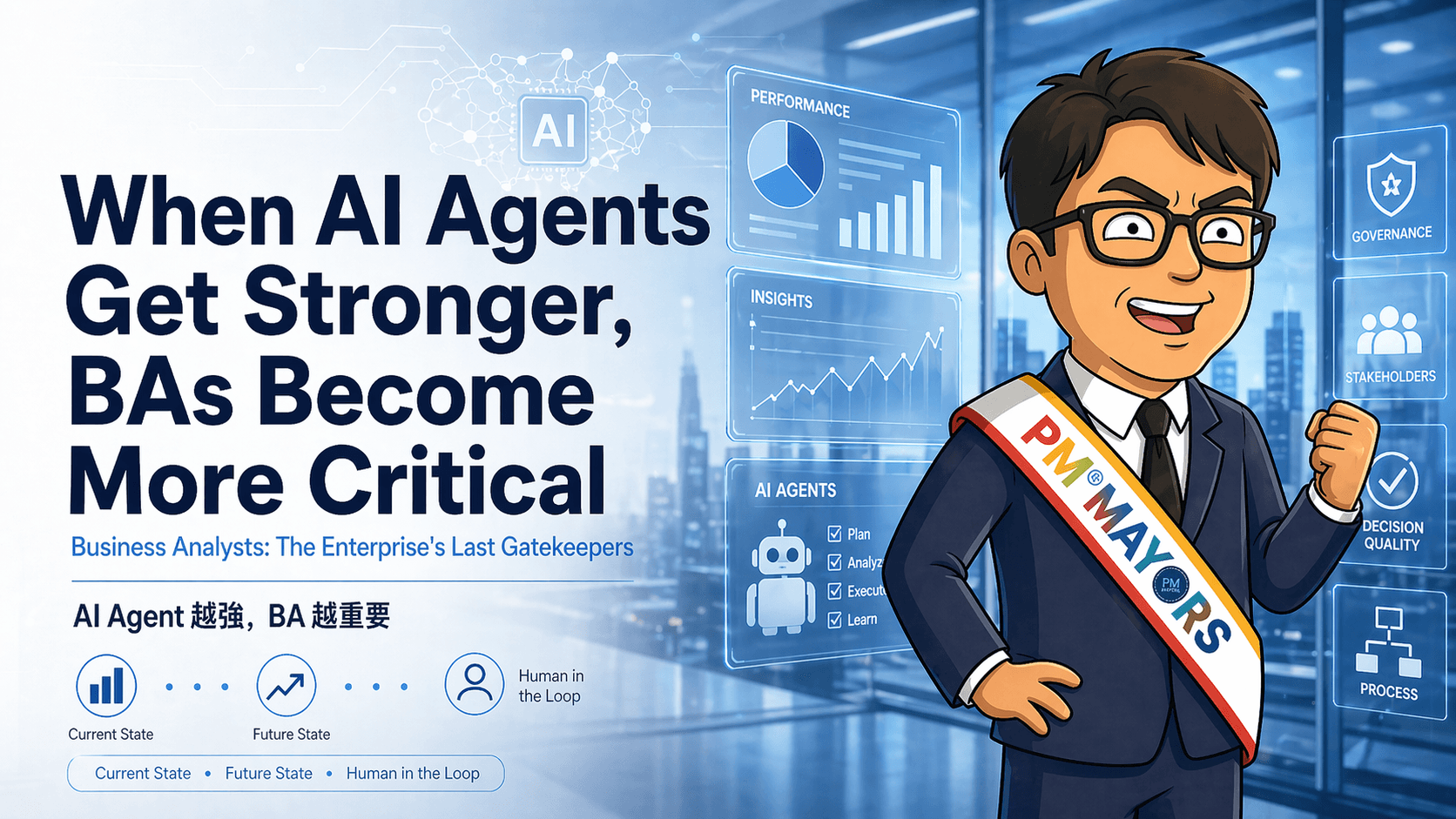
As AI Agents Become More Autonomous, Business Analysts Will Become the Enterprise’s Last Gatekeepers
Why the next five years may elevate the Business Analyst into one of the most important human control points in the age of agentic AI
There is a growing misconception in the market that as AI agents become more capable, the Business Analyst will inevitably become less relevant.
At first glance, that assumption feels reasonable. If AI can already summarize workshops, generate business requirements, draft process maps, compare solution options, identify risks, and even orchestrate workflows across tools, then it is tempting for executives to conclude that the BA role is simply another knowledge function waiting to be compressed by automation.
But from where I stand, that conclusion is not only premature. It is strategically dangerous.
As agentic AI becomes more embedded in enterprise operations, the Business Analyst will not become less important. In many organizations, the BA may instead become one of the most critical gatekeepers of decision quality, transformation integrity, and human judgment.
And no, I am not referring to the traditional perception of the BA as a documentation specialist or requirement coordinator.
I am talking about a different kind of Business Analyst entirely: the one who understands the enterprise’s real operating condition, who can diagnose the difference between visible problems and structural causes, who can define what the organization’s future state should actually look like, and who can determine where human judgment must remain in place even when AI is technically capable of doing more.
That is the BA the next five years will desperately need.
The market is misunderstanding the real role of the Business Analyst
Many companies have spent years underusing their BAs.
Some organizations treat the BA as a support function for the Project Manager. Others position the BA as a translator between business stakeholders and technical teams. In some environments, the role is reduced to requirement documentation, workshop facilitation, backlog cleanup, or stakeholder note consolidation.
All of those activities may be part of business analysis, but none of them fully define the discipline.
The true value of business analysis has never been about writing cleaner documents. It has always been about helping the enterprise make better decisions about change.
That is why, in the BABOK framework, the important concepts are not limited to requirements gathering. At a deeper level, business analysis is concerned with understanding the current state, defining the future state, identifying the gap between them, evaluating value, and guiding change.
In other words, the BA’s real job is not merely to document what people ask for. The BA’s real job is to help the organization determine:
- where it is now,
- where it should go,
- what stands in the way,
- which gaps matter,
- which changes create value,
- and which decisions require careful human judgment.
That work becomes more important, not less, when AI agents enter the picture.
AI agents do not eliminate the need for analysis—they increase the need for analytical accountability
One of the biggest mistakes leaders make is confusing faster output with better judgment.
AI agents are changing the economics of execution at a breathtaking speed. Tasks that used to consume hours or days of human effort—meeting synthesis, process summarization, requirement decomposition, option comparison, first-draft business logic, early-stage impact analysis—can now be produced in minutes.
Naturally, many people interpret that compression as the beginning of role obsolescence.
I see it differently.
When the cost of producing analysis goes down, the value of judging that analysis correctly goes up.
Someone still has to determine whether the AI-generated output is grounded in reality. Someone still has to check whether the problem framing is wrong, whether the proposed future state is strategically sound, whether the identified gap is meaningful, and whether the recommended course of action is safe, governable, and worth pursuing.
This is exactly where the Business Analyst becomes more powerful.
Because in an enterprise flooded with AI-generated structure, the scarce resource will not be documentation.
The scarce resource will be analytical responsibility.
Current state vs. future state is no longer theory—it is the real governance battleground
In many organizations, executives say things like:
“We need AI.”
“We want to automate this workflow.”
“We need agents to improve efficiency.”
Those statements may sound modern, but they often reveal a deeper problem: the organization has not actually developed a precise understanding of its own reality.
A company’s current state is not just the official process map. It is the messy truth beneath the process map: informal workarounds, hidden dependencies, fragmented systems, inconsistent data, conflicting KPIs, overlapping ownership, political friction, compliance constraints, legacy controls, and unspoken operating habits.
Likewise, the future state is not a slogan about digital transformation. It is not a slide saying “AI-powered enterprise” or “intelligent automation at scale.” A real future state must define what the organization is actually trying to optimize—speed, quality, resilience, customer experience, governance, cost structure, risk posture, or decision responsiveness—and must clarify what kind of human and machine participation is appropriate at each level.
The difference between these two states is where the real work begins.
And that difference is not just a technical problem. It is a business problem, an organizational problem, and often a governance problem.
That is why the BA becomes central.
Not because the BA can draw the gap elegantly, but because the BA can determine which gaps should be closed, which gaps should be tolerated, which gaps are symptoms of deeper structural issues, and which gaps should never be handed to an AI agent without human oversight.
That is not a support task.
That is gatekeeping.
The next-generation BA will be a guardian of decision quality
As AI agents become more persuasive, one new enterprise risk will grow rapidly: the illusion that polished output equals sound judgment.
AI can generate comprehensive-looking requirement sets. It can create structured future-state models. It can produce scenario analysis that feels rigorous. It can recommend priorities with confidence. It can sound coherent, strategic, and decisive.
But coherence is not the same as truth.
And confidence is not the same as fitness for context.
This is why the future BA will not merely be a requirements professional. The future BA will increasingly operate as a guardian of decision quality.
That means asking harder questions:
- What assumptions are embedded in the AI-generated recommendation?
- What constraints has the model failed to account for?
- Which trade-offs are hidden beneath the apparent efficiency gain?
- What downstream risks are being externalized?
- What human accountability disappears if this becomes fully autonomous?
- What organizational damage could occur if this recommendation is wrong?
As the volume of AI-generated options increases, enterprises will desperately need professionals who can prevent the organization from confusing more outputs with better choices.
That is where the strongest Business Analysts will stand.
Human in the loop is not about clicking “approve”—it is about holding contextual authority
A shallow interpretation of human in the loop says that a person should approve AI output before action is taken.
But that is far too simplistic.
A real human control point is not just someone who signs off at the end of the process. A real human control point is someone with enough contextual understanding to determine whether the proposal should even move forward in the first place.
That requires the ability to ask:
- Is this AI-generated recommendation based on an accurate understanding of the current state?
- Does the proposed future state align with enterprise strategy and operating reality?
- Are there hidden assumptions, invisible dependencies, or governance blind spots?
- Is the risk reversible, or would failure create material damage?
- Should this activity be automated, augmented, delayed, or blocked?
- At what point must human judgment override speed?
That kind of oversight is not generic management.
It is sophisticated business analysis.
This is why I believe that over the next five years, the Business Analyst may become one of the most important human-in-the-loop checkpoints in the modern enterprise.
Not because the BA has the biggest title.
But because the BA may be the one best positioned to say:
“Yes, the agent can do this. But should it?”
PMs, Product Owners, and PMOs will need this upgraded BA more than ever
This argument is not about replacing Project Managers, Product Owners, or PMOs. It is about recognizing that all three roles will need stronger business analysis as AI agents become part of enterprise execution.
For Project Managers
The PM’s challenge in the future will not simply be delivery delay. It will be accelerated misdirection.
If AI agents can help teams move faster, then weak problem framing becomes even more dangerous. A project can gain momentum while heading toward the wrong outcome. The BA helps preserve alignment between business need and delivery velocity.
For Product Owners
The PO’s challenge will not be a shortage of ideas. It will be an explosion of plausible ideas, AI-generated features, simulated feedback loops, and well-structured suggestions. The BA helps distinguish authentic value from algorithmically attractive noise.
For PMOs
The PMO’s challenge will be that governance can no longer remain static, template-driven, or compliance-only. In an agentic environment, governance must become dynamic, risk-sensitive, and decision-aware. The BA can help translate governance principles into operational checkpoints and evaluative mechanisms.
So no, the BA is not becoming less important.
The BA is becoming the person who helps these roles maintain control in a world where AI increases speed, complexity, and ambiguity at the same time.
The most valuable BA will not resist AI—they will collaborate with AI to perform dynamic evaluation
The future will not belong to BAs who try to protect themselves by refusing AI.
Nor will it belong to organizations that hand everything over to AI in the name of efficiency.
The future will belong to Business Analysts who know how to use AI to expand analytical reach while preserving human judgment at the right moments.
That means using AI to:
- synthesize evidence across fragmented current-state signals,
- detect process drift and hidden inconsistencies,
- compare multiple future-state scenarios,
- simulate downstream implications,
- surface trade-offs faster,
- and continuously monitor whether implemented change is truly creating value.
But the BA will still be the one responsible for deciding what matters, what is credible, what is acceptable, and what requires escalation.
This is the collaboration model that will matter.
Not AI replacing analysis.
Not humans approving AI once at the end.
But AI amplifying analytical capacity while the BA protects decision integrity.
PM Mayors’ final broadcast
Let me put it plainly.
The most vulnerable organizations in the next five years will not necessarily be the ones that fail to adopt AI agents. In many cases, they will be the ones that adopt them too quickly without strengthening the human gatekeeping functions needed to guide them.
They will automate ambiguity.
They will accelerate flawed assumptions.
They will scale incomplete reasoning.
And they will mistake machine-generated structure for business truth.
That is why I believe the Business Analyst is not disappearing in the age of agentic AI.
The Business Analyst is evolving.
And in the strongest organizations, that evolution will turn the BA into one of the enterprise’s final and most necessary gatekeepers—the person who can still ask, with discipline and courage:
Where are we really now?
What future are we actually trying to build?
Which gaps matter, and which ones are dangerous distractions?
What should be automated, and what must remain human?
And when AI says, “I can do it,” who has the judgment to respond, “That is not the same as being allowed to do it”?
My answer is simple.
In the age of AI agents, the Business Analyst is not stepping off the stage.
The Business Analyst is moving closer to the control tower.
Tags:
Want to Know More?
Get in touch to discuss AI transformation, teaching or speaking
